top of page


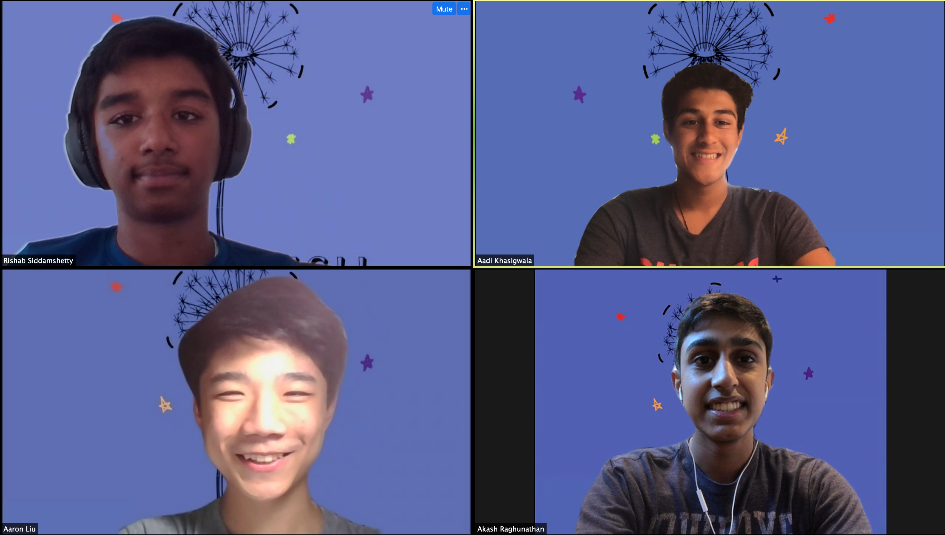
Rishab Siddamshetty, 15, Aadi Khasgiwala, 15, Akash Raghunathan, 15, and Aaron Liu, 15, all from Dallas, TX, are one of this year's competitors in the i.Invest National Youth Business Competition. The team members are the cofounders of MyWish. MyWish integrates simplicity with innovation to provide charities with a simple solution to acquire supplies, money, and volunteers.

We spoke with Aaron, Akash, Aadi, and Rishab to learn more about the business venture:

Tell us about your business:

Every charity needs three things: supplies, money, and volunteers. Our app, MyWish, solves these issues by hosting a user-friendly interface that connects charities to donors, so philanthropists can donate money and supplies to their favorite charities. Also, our multifarious platform allows charities to create public profiles, allowing for volunteers to connect with them directly through our app’s chat function. In order to cover the costs of hosting this platform, the supplier is charged $3.00 for supply-based transactions and 4% for cash-based transactions. MyWish also allows for an in-app subscription which includes an unlimited wish list, a more advanced profile, and guaranteed advertisement on the MyWish homepage. Essentially, our app aims to provide a more long-term solution for charities by creating strong communities as opposed to one-time transactions.

Who or what inspired you to start MyWish?

MyWish was formed to learn about charity’s needs and wishes and brainstorm how our team could help fulfill them. Many of our team members were inspired by an underprivileged community center that we volunteered at, and we were disappointed that so many people waste items that charities could be utilizing. As we went through our development phase, our team thought about the various competitors in the field, such as Giftster, Offer-Up, and more. Our team built MyWish with a goal to help charities, as opposed to any of our other competitors.

How will MyWish impact the world?

The growth of users will benefit charities by giving them the ability to get the supplies and volunteers they need with a single click. Volunteers and donors will also benefit by having a user-friendly platform to reach the forefront of philanthropy. Using MyWish, more people will learn about these organizations, and in turn, more people will supply them with the everyday materials they desperately need. Our product strives to help charities. It is reported that nearly 5,000 charities are forced to close their doors every year and shut down due to a lack of supplies, volunteers, and money. Our company can help alleviate the struggles charities face daily by providing a platform for more people to donate, supply, and contact these charities.

What are the next steps?

We are seeking $15,000 to fund advertising and marketing our product; in additional to financing additional app development, server hosting, and cover further personal expenses.

To mentor or support, email info@i-investcompetition.com.


Matthew Fan, 16, of Frisco, TX, is one of this year's competitors in the i.Invest National Youth Business Competition. Matthew is the founder of ProductiveTime, a smart time management app and a goal achievement tool that automatically plans various daily tasks and to-dos.

We spoke with Matthew to learn more about the business venture:

Tell us about your startup:

ProductiveTime is an application serving both as a time management and a goal achievement tool. The app allows the user to add and create various tasks he or she regularly performs along with the amount of time they usually take. With this information, ProductiveTime outputs a personalized schedule specifically tailored to each user's needs. With this, ProductiveTime delivers the best and most efficiently organized schedule based on your previous schedules. ProductiveTime also doubles as a helpful way to accomplish your goals. If the user has a desired goal or habit they want to develop, ProductiveTime can also seamlessly include this into their daily schedule. ProductiveTime relies on machine learning to help tailor the app to the individual user.

Who or what inspired you to start ProductiveTime?

My mother was the main inspiration behind the development of ProductiveTime. Always working and providing for our family, she struggled to balance her responsibilities both at home and at work. My father, too, often worked at home. The environment of our house was distracting, and seeing how hard they worked, I really wanted to help them alleviate their stress. However, I was always occupied with schoolwork. What if, I thought, there was a way to generate a personalized schedule automatically, and then ProductiveTime was born.

How will ProductiveTime impact the world?

ProductiveTime can help solve common organizational problems. It can also serve as a way for company employees to manage their projects and priorities better. ProductiveTime can seamlessly incorporate habits you would like to create into your schedule, ultimately serving as a way for users to manage their everyday tasks and duties, while also developing habits that will have a positive impact on the rest of their lives. ProductiveTime will enrich the community around me by improving the habits and lifestyles of individuals through better time management skills. I personally know the stress and energy needed to cope with the endless tasks we all face.

What are the next steps?

We are seeking funding to build the ProductiveTime app and website. Although the algorithm behind the app is mostly complete, we still need a simple and attractive design for the look of our application. With the app completed, we will be able to release a beta version for testing and customer feedback. This way, we can quickly improve to develop the best possible app for our customers. Our website will serve to inform potential customers about how ProductiveTime works and how it can positively impact their lives. If they [customers] are interested, they can also enter their email to learn more about ProductiveTime from the monthly emails we will send. In addition, this website will also serve as a platform for customers to provide feedback and suggestions about what they want to see in the product. After the release of ProductiveTime next year, the interest we have generated on our website will translate into our first customers, and allow us to hit the ground running as soon as we launch ProductiveTime.

To mentor or offer support, email info@i-investcompetition.com.


Espen Garner, 17, of Laguna Hills, CA, along with team members, Ian Kim,18, of Fairfax, VA, and Giana Valencia, 18, of Santo Domingo, Dominican Republic are one of this year's competitors in the i.Invest National Youth Business Competition. The team members are the cofounders of Cognality, a virtual reality startup that provides cutting edge rehabilitative technology for autistic children to help mitigate the effect of meltdowns.

We spoke to Espen, Ian, and Giana to learn more about their startup:

Tell us about Cognality:

One out of 59 children struggle every day with autism spectrum disorder (ASD), according to the Centers for Disease Control (CDC). People with autism are usually highly sensitive to their environments. Autistic children are especially sensitive to stimuli and become easily overwhelmed. This sensitivity may lead to a meltdown, shouting, screaming, crying, kicking, biting, etc. Cognality is a new VR product that provides effective, accessible, and customizable therapy to its users with calming VR scenes. As opposed to applied behavioral analysis therapies that require hours of training, Cognality can be initiated in a minute to help mitigate ASD related meltdowns.

Who or what inspired you to start Cognality?

A few years ago, Espen's neighbor, three-year-old Jack, was diagnosed with autism. Espen watched as he started daily behavioral therapy to help address his newfound challenges. One of these challenges was meltdowns, where Jack lashed out after being overwhelmed. These meltdowns impacted Jack and his family because he became limited in his activities and social interactions. In a matter of minutes, a fun outing to the mall could become overwhelming for Jack. Thinking about Jack and the many other autistic kids out there, our team came up with an affordable intervention to stop meltdowns using cutting edge VR technology.

How will Cognality impact the world?

The CDC estimates that $61-66 billion is spent annually on care for people with autism. Much of this is spent on expensive ABA (advanced behavioral analysis) therapy. Unfortunately, many children do not have access to this form of therapy because they either have a lack of healthcare coverage or because they don't have access to an ABA therapist. These children are left with few resources. However, Cognality would provide a cost-effective option for them. We have a big vision for Cognality: that it both helps its customers during the actual meltdown, and that it provides a lasting feeling of empowerment to autistic children and their caregivers. We hope these children feel able to try new social situations and ultimately enjoy life to the fullest.

What are the next steps?

We are initially targeting Cognality for use in children ages 4 - 12 who have level 1 or 2 autism and thus are high functioning and verbal. This means our market targets 500,000 children in the US, but as acceptance and traction grow, we believe we can expand Cognality to help all 5 million US children with autism. With this vision in mind, we will use our funding to help the large and currently underserved population of the autistic community access the therapeutic services they need.

To learn more about Cognality, visit their website, https://www.cognalityvr.com/, or Facebook page, https://www.facebook.com/Cognality/. To mentor or offer support, email info@i-investcompetition.com.


bottom of page